Key Points
- Saudi Arabia is a tax-free zone for residents. Both citizens and expatriates keep 100% of their personal income.
- Corporations still have to pay some form of taxes. This article clarifies the difference in tax rates for businesses owned by Saudis and those owned by foreigners.
- No taxes on casino winnings. You don’t have to pay anything for what you win from online gambling.
- Saudi Gambling laws are strict. At the moment, neither online nor physical casinos operate in the kingdom. Players accessing online betting sites have to do so discreetly.
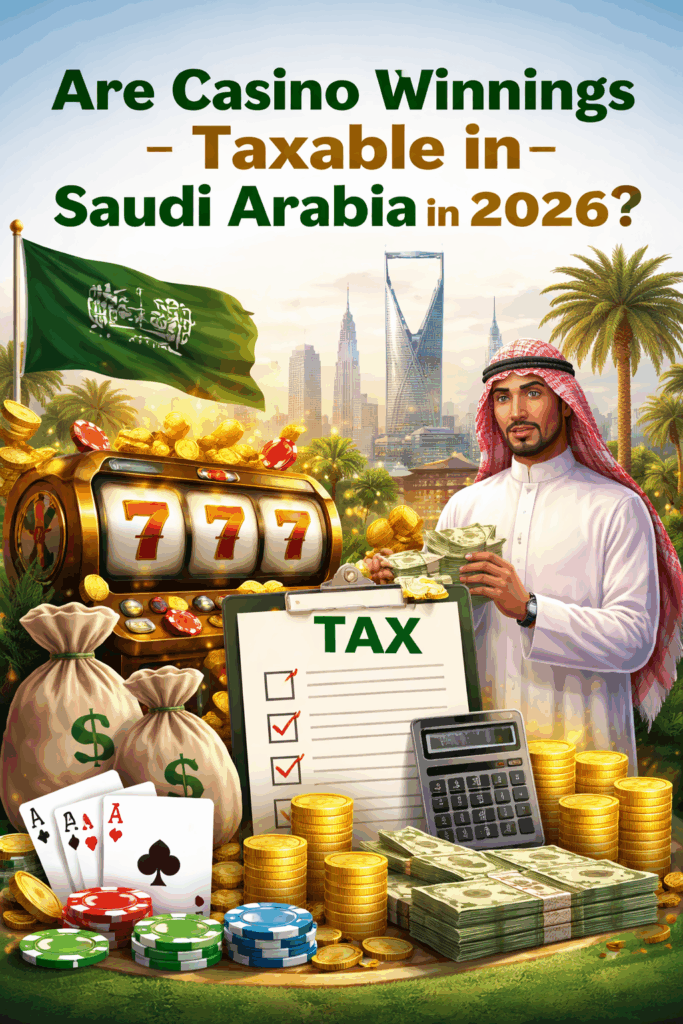
They say nothing in life is certain except death and taxes, but in countries like Saudi Arabia, even taxes feel negotiable. The reality is that taxation rules vary widely across the world, shaped by local laws, religious principles, and economic policies.
When it comes to gambling, the question becomes even more complicated, especially when it is banned or not regulated. So where does that leave casino winnings?
If a Saudi resident earns money from gambling abroad or through online casino platforms in Saudi Arabia, are those winnings subject to tax back home?
To understand this, we have to look beyond simple assumptions and explore how Saudi Arabia approaches income, legality, and financial obligations in 2026. Read on.
How Taxes Work in Saudi Arabia?
If you’re used to income taxes in other countries, the Saudi Arabia system might feel like a reset. Instead of focusing on individual earnings, the system relies more on business taxation, consumption, and religious contributions.
Below, we discuss the most common types of taxes and how Saudi Arabia deals with them.
Personal Income Tax
The country does not charge any form of taxes on personal income or salaries. This covers both indigenes and expatriates. For this reason, it’s become highly attractive to foreign workers.
Nevertheless, you’re not entirely free from financial obligations. For example, expatriates are still required to pay residency-related fees, including charges for dependents. However, even residency permits can be paid for at once.
The country offers a limited residency permit at SAR 100,000 annually and permanent residency for SAR 800,000. Individuals who plan to stay for many years or permanently don’t have to keep paying yearly.
Corporate Tax
Corporate taxes in Saudi Arabia primarily apply to foreign-owned businesses. These entities are subject to an income tax rate of around 20% on their profits. The goal is to ensure that international companies operating within the kingdom contribute to public revenues.
Businesses owned by citizens and Gulf Cooperation Council (GCC) nationals are treated differently. They’re free from corporate taxes but fall under the Zakat system, explained below.
Zakat
Zakat is one of the five pillars of Islam, which means it is compulsory for Muslims. The practice requires every sane Muslim who owns wealth over a certain amount (nisab) to set aside 2.5% of their wealth. The collection is then distributed to the poor and those in need.
Since Saudi Arabia is an Islamic country, zakat is followed there. However, the government does not enforce or collect the money from individuals. People usually calculate and distribute it privately.
It’s different for corporations owned by Saudis or other GCC nationals in the country. Through the Zakat, Tax, and Customs Authority (ZATCA), 2.5% is collected from eligible companies.
Value Added Tax (VAT)
The Kingdom of Saudi Arabia introduced VAT in January 2018 as a part of its broader economic reforms to reduce reliance on oil revenues. It was initially set at 5%, but was later increased to 15% in 2020.
VAT is applied to most goods and services, making it one of the primary sources of government revenue. Here are some transactions on which VAT is charged:
- Retail purchases (clothing, electronics, groceries – except some essentials)
- Restaurant and dining services
- Online and digital services
- Professional services
In summary, consumers pay VAT indirectly whenever they spend money.
Can Online Gambling Winnings be Taxed?
In Saudi Arabia, there are no taxes on gambling winnings, whether they come from online casinos or offline platforms.
This is partly due to the absence of a personal income task. But more importantly, because gambling is illegal. Both physical and online betting centers are completely banned in the country.
In practical terms, casino winnings exist outside the system entirely. They are not taxed, but they’re also not protected, regulated, or acknowledged in any official capacity. This creates a situation where players have no obligations, but also no rights.
That said, this does not mean the activity goes unnoticed in the country. Financial transactions linked to gambling may raise red flags, especially when they involve foreign transfers and unusual patterns of deposits and withdrawals.
How to Gamble Without Issues
Despite the restrictions, many casino players gamble by accessing international online casinos and sportsbooks. Since these platforms are hosted in other countries, they’re not subject to the laws of the kingdom.
Nevertheless, if you want to access these sites from Saudi Arabia, you have to do so carefully. Otherwise, you could end up playing at unsafe sites or get into legal trouble.
Here are key steps to playing safely.
Choose the Right Casino
You must be careful when selecting where to gamble online. While there are many excellent online casinos, there are also many fraudulent ones. Thus, your choice of a betting site is highly crucial.
The first thing you must check is how safe the platform is. A good online casino must utilize industry-standard systems like SSL encryption to protect your private information and payments on its site. Trustworthy sites also hold licenses from reputable gambling authorities.
Other things to consider while choosing are:
- Quality of games collection
- Variety of bonuses
- Payment system
- Customer support
- Mobile accessibility
- Website availability in Arabic.
Play with VPNs
With VPNs, you can bypass geographical restrictions to access online casinos in Saudi Arabia that may not be accessible directly. The best regions to connect to are those with unregulated gambling markets to avoid having to follow the strict rules of other national regulators.
Before you start, it’s important to confirm if your chosen casino allows VPN connections. Some casinos ban players found using VPN, while some might start asking for documents to prove you’re in the country you connected from.
Use Crypto Payments
Saudi online casinos accept a wide range of payment options, including cryptocurrencies, e-wallets, prepaid vouchers, debit/credit cards, and instant bank transfers.
When you use cryptocurrencies, you enjoy the security, transparency, anonymity, and speed of the blockchain. Since the payments do not go through traditional financial institutions, it’s easier to stay unnoticed.
Conclusion
Casino winnings are not taxable in Saudi Arabia, and that’s largely because gambling is prohibited under local law. There’s no regulatory system, no reporting requirements, and no tax obligations tied to your winnings.
Therefore, you get to keep everything you win from online gambling. At the same time, it also means that your money or data is not protected by the law since the activity is not recognized.
If you’re planning to play online casino games, you should worry less about taxes and more about understanding how international casinos work. Play at only reputable casinos that accept Saudi players.
-
Are casino winnings taxable in Saudi Arabia?
-
Do I need to report gambling winnings?
-
Will banks block gambling transactions?
-
Are there legal casinos in Saudi Arabia?
Omar has worked in the online gambling industry since 2015. He has tested hundreds of casinos and written thousands of articles about online casinos and gambling, establishing himself as a trusted expert for Saudi players.